top of page
PROBLEM: How can Smart augmented reality (AR) glasses be used by installers to safely install insulation in a loft space?
Augmented Reality

Context
This project explores how smart AR glasses can be used
in real world projects by installers, to install loft insulation safely, with the use of installation guidance, voice activated prompts and safety hazard spotting.
The implementation of this new technology for installers
using Knauf Insulation products, is helping them to be more efficient and safely fit loft insulation, which then also provides reassurance to them and the future homeowners.

Process
The project began with user interviews, gathering
insights into needs and pain points. Using these findings,
a descriptive persona was created.

Research on the use of smart glasses proved that this is already being used within the construction industry on sites for health and safety reporting and is becoming more accessible to the industry.
This project takes this tool and creates a new concept as a training tool, with the features of using AI voice prompts and
speech recognition, to train the user whilst identifying safety hazards.

I sketched workflows and prototyped low, medium and
high- fidelity prototypes in Figma, including visual cues, voice activated buttons, overlay of hazards and an AI generated voice to read installation steps.
I also designed User interface elements that the user would see through the glasses projected in front of them including, buttons, text and icons.


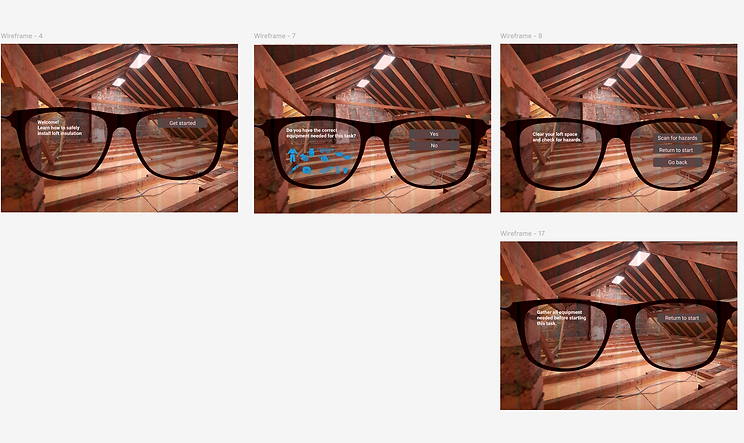
By user testing, prototypes were developed, and edits were made to user interface elements, to help with the overall navigation through the installation process.
Challenges
One challenge I faced was using 2D software, Figma to create AR visuals, the user struggled in the early prototyping stages to understand the navigation without the visual images on screen and the navigation of the voice activation and audio guidance, as Figma did not have the capability to implement AI audio content.
Solution
The final high-fidelity prototype introduced the user to
more clear navigation, with audio and visual images being implemented, to demonstrate this as a feature. The user was able to see this aligned with their needs and could see how this would be used in a real-world setting.
Outcome
Overall, the project shows how new AR technology being implemented can make the installers job more efficient and carried out in a safe way. The project is now in a place to
be taken into AR software's, such as Adobe Aero to be further developed and installed onto the smart AR glasses.
Reflection
This project strengthened my skills in UI and UX design.
I learned how new technology such as, AR can provide efficient solutions for users and made me interested in exploring emerging technologies further.
With more time on this project, I would like to revisit this
at its current stage and look at AR software's such as Adobe Aero to see how this can be integrated. This would again need to go through the prototype and testing stage to be further developed. By doing this it would also expand my knowledge on AR software as this is something I have not created before.
bottom of page